
Mobile on-board power supply systems
Research Field
The number of electronic components in motor vehicles has risen sharply in recent decades. However, complexity, costs and safety or reliability can hardly be controlled with such architectures anymore. Recent developments are aiming for a significant reduction in the number of components. These are known as zone or central architectures, where vehicle functions are concentrated in a small number of electronic systems. An optimum electronics architecture promises minimum costs and maximum safety and reliability at the same time.
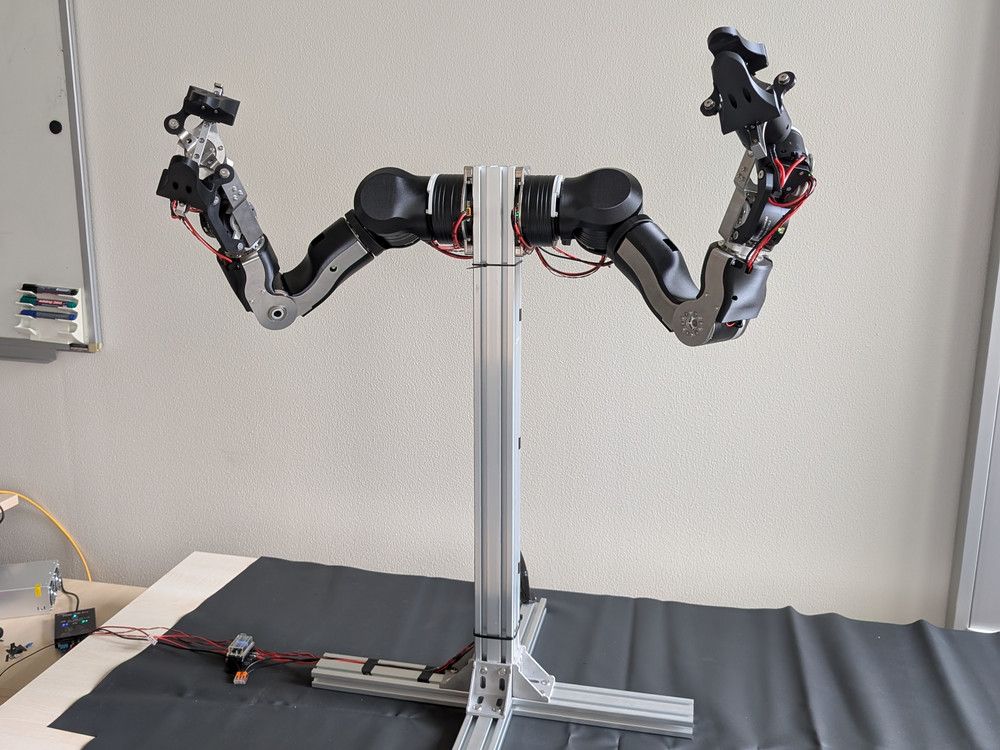
These developments can be observed in all mobile systems. Cars, airplanes, ships, and even robots require cost-effective solutions that also offer high reliability and meet very stringent safety requirements, all while adhering to weight and space constraints.
Actuators and logic units often share a common power and bus infrastructure. While this high degree of integration reduces the amount of wiring required, it also places comparable demands on voltage stability, electromagnetic compatibility, and reliability.
Finding optimal architectures is a major challenge, one that is further complicated by ever-increasing functional scope. To manage and meet the high level of complexity and the various requirements early in the development process, there is no alternative to virtual and simulation-based design.
Within this research focus, methods and processes are being developed to optimize vehicle power supply systems with one or more voltage levels (12 V, 48 V, 400 V, etc.) in terms of voltage quality, cost, installation space, and weight. In addition, methods for centralized fault diagnosis and predictive maintenance are being developed and further optimized.
Methods
Modeling and simulation
For on-board power system simulation, work is being done on modeling and simulation methods for many relevant issues. Among others, the following aspects are considered:
- Stability analyses at various operating points
- Thermal capacity of cable insulation
- Thermal capacity of connector systems
- Transient pulses in power distribution: causes and effects
- Smart electronic fuses
Metrological analyses
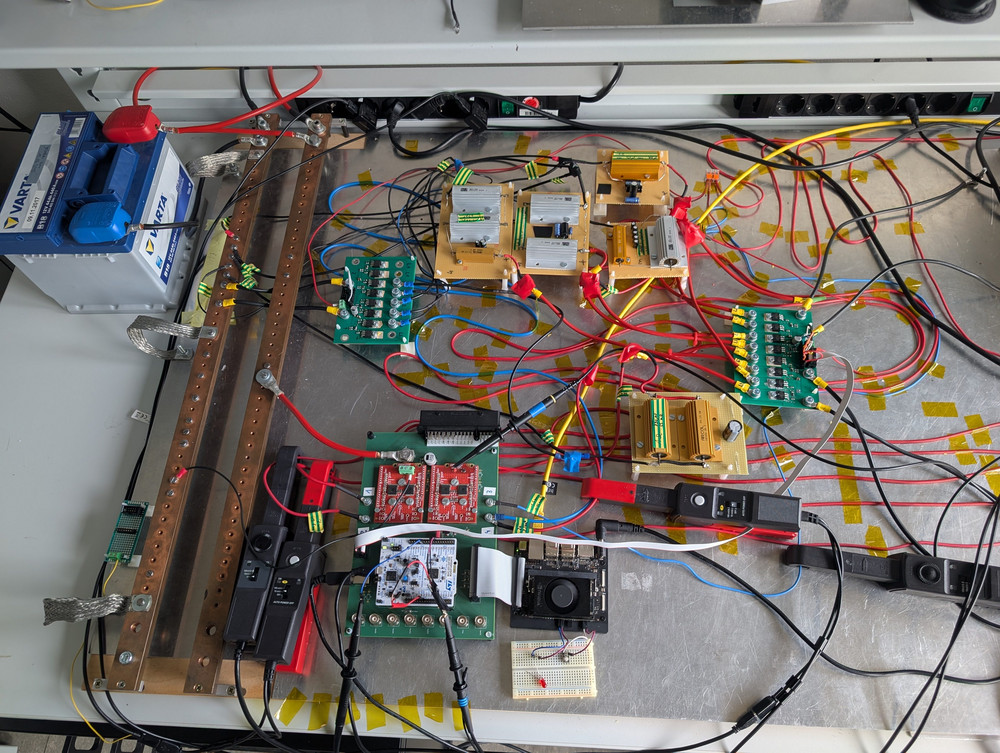
On-board electrical system configurations can be tested in complex test setups. The following components are available for this purpose:
- Sources up to 500 A and 80 V or 500 V and 30 A
- Electronic loads up to 10.5 kW, 510 A and 80 V
- AC/DC 4-quadrant voltage amplifiers with 600 A peak current and ±70 V
- Arc test bench for 48 V setups
- Extensive current and voltage measurement technology
- Extensive temperature measurement technology
- Configurable electronic and intelligent fuses